No Tax on Overtime Explained: Complete Guide to the 2025 Tax Law
Everything you need to know about the No Tax on Overtime law signed July 4, 2025. Learn about deduction limits, eligibility requirements, and how to maximize your tax savings.
The No Tax on Overtime provision is now law! Signed by President Trump on July 4, 2025, as part of the One Big Beautiful Bill Act (H.R. 1), this landmark legislation allows millions of American workers to deduct qualifying overtime pay from their federal taxable income.

Key Facts at a Glance
| Detail | Information |
|---|---|
| Law Status | Signed into law July 4, 2025 |
| Effective Period | January 1, 2025 - December 31, 2028 |
| Maximum Deduction | $12,500 (single) / $25,000 (married filing jointly) |
| Income Phase-out | Begins at $150,000 (single) / $300,000 (married) |
| What Qualifies | The "half" portion of time-and-a-half overtime pay |
What Does "No Tax on Overtime" Actually Mean?
Despite its name, No Tax on Overtime is technically a federal income tax deduction, not a complete tax exemption. Here's what that means:
- You can deduct qualifying overtime compensation from your taxable income
- The deduction only applies to the premium portion of overtime pay (the "half" in time-and-a-half)
- Social Security and Medicare taxes (FICA) still apply to all overtime earnings
- State income taxes may or may not follow the federal deduction (varies by state)
Who Is Eligible?
To qualify for the No Tax on Overtime deduction, you must:
- Be a W-2 Employee - Independent contractors and gig workers do not qualify
- Receive FLSA-Covered Overtime - Your overtime must be required under the Fair Labor Standards Act
- Meet Income Requirements - Full deduction available for income under $150,000 (single) or $300,000 (married)
- Work Over 40 Hours - Only hours exceeding 40 per week qualify as overtime
Industries That Benefit Most

- Healthcare: Nurses, medical technicians, hospital staff
- Manufacturing: Factory workers, assembly line employees
- Transportation: Truck drivers, delivery personnel
- Construction: Laborers, equipment operators
- Retail & Hospitality: Store managers, restaurant workers
- Emergency Services: Firefighters, EMTs, police officers
How Much Can You Save?
Your savings depend on several factors:
Example Calculations
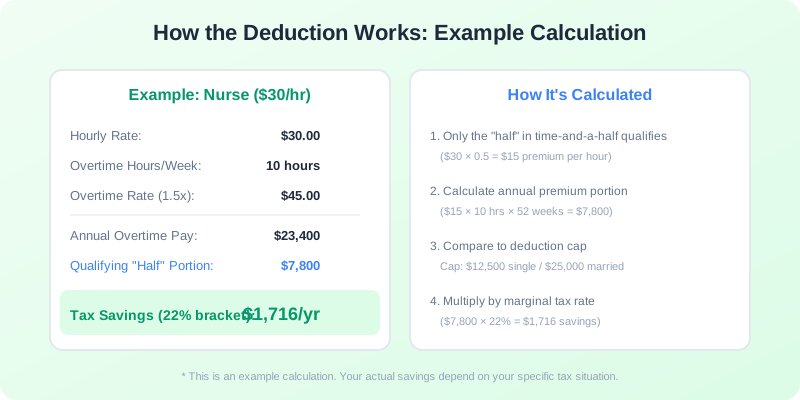
Example 1: Nurse earning $30/hour with 10 hours weekly overtime
- Annual overtime pay: $23,400 (10 hrs × $45 × 52 weeks)
- Qualifying deduction: ~$7,800 (the "half" portion)
- Tax savings at 22% bracket: ~$1,716/year
Example 2: Construction worker earning $25/hour with 15 hours weekly overtime
- Annual overtime pay: $29,250 (15 hrs × $37.50 × 52 weeks)
- Qualifying deduction: ~$9,750 (the "half" portion)
- Tax savings at 12% bracket: ~$1,170/year
Use our calculator for your personalized estimate!
How to Claim the Deduction
For Tax Year 2025 (Filing in 2026)
- Track Your Overtime: Keep records of all overtime hours worked
- Request Documentation: Ask your employer for overtime pay records
- File Your Return: Claim the deduction on your 2025 tax return
- Use IRS Guidance: Follow official IRS instructions for the new deduction
For Tax Year 2026 and Beyond
Starting in 2026, employers must report overtime compensation in Box 12 of your W-2 form using the new "TT" code. This makes claiming the deduction easier.
Important Limitations
Deduction Caps
- Single filers: Maximum $12,500 deduction
- Married filing jointly: Maximum $25,000 deduction
Income Phase-outs
The deduction begins to phase out for higher earners:
- Single filers: Phase-out starts at $150,000 MAGI
- Married filing jointly: Phase-out starts at $300,000 MAGI
What Doesn't Qualify
- Regular hourly wages (first 40 hours)
- Salary compensation
- Bonuses or commissions
- Independent contractor income
- Double-time premium pay (only the first 0.5x premium qualifies)
Common Misconceptions
Misconception 1: "All my overtime is tax-free"
Reality: Only the premium portion (the extra 0.5x in time-and-a-half) qualifies for the deduction, and it's a deduction, not an exemption.
Misconception 2: "My paycheck will immediately increase"
Reality: Your employer will continue withholding taxes as usual. You'll claim the deduction when you file your tax return, receiving savings as a larger refund or lower tax owed.
Misconception 3: "This eliminates all taxes on overtime"
Reality: You still pay Social Security (6.2%) and Medicare (1.45%) taxes on all overtime earnings.
State-by-State Considerations
Not all states follow the federal tax deduction:
- No State Income Tax: Alaska, Florida, Nevada, New Hampshire, South Dakota, Tennessee, Texas, Washington, Wyoming - no state impact
- States That Decoupled: Some states (like Colorado) have passed legislation requiring overtime to remain taxable at the state level
- States Following Federal: Many states automatically conform to federal tax law
Check your state's specific rules or use our calculator with state selection.
Timeline: What Happens Next?
- Now - Dec 31, 2025: First full year of the deduction
- Early 2026: File 2025 taxes and claim the deduction
- Jan 1, 2026: New W-2 reporting requirements begin (Box 12, Code TT)
- Dec 31, 2028: Current law expires (unless extended by Congress)
Conclusion
The No Tax on Overtime law represents a significant tax benefit for millions of American workers. While the name is slightly misleading (it's a deduction, not an exemption), the savings can be substantial—potentially thousands of dollars per year for workers who regularly put in overtime hours.
Ready to see your potential savings? Use our free No Tax on Overtime Calculator to get a personalized estimate based on your hourly rate, overtime hours, and tax situation.
This article is for informational purposes only and does not constitute tax advice. Consult a qualified tax professional for guidance specific to your situation.